Once more, I offer my annual list of the
seemingly-arbitrary “worth repeating” (given ‘best’ is such an inconclusive,
imprecise designation), constructed from the list of Canadian poetry titles
I’ve managed to review throughout the past year. This is my twelfth annual list [see also: 2021, 2020, 2019, 2018, 2017,
2016, 2015, 2014, 2013, 2012, 2011] since dusie-maven Susana Gardner
originally suggested various dusie-esque poets write up their own versions of
same, and I thank her both for the ongoing opportunity, and her original prompt.
I can’t get to everything (and the fact that I keep
trying is seeming to be increasingly ridiculous), which means there are
multiple titles this year I haven’t managed to properly respond to, including
Lisa Robertson’s Boat (Coach House Books, 2022), Dale Tracy’s Derelict
Bicycles (Anvil Press, 2022), natalie hanna's lisan al'alfour (ARP Books, 2022) or Manahil Bandukwala’s MONUMENT (Brick
Books, 2022) (among others, I’m sure). And didn’t Kasia Van Schaik’s short
story collection We Have Never Lived On Earth (University of Alberta
Press, 2022) just land on my doorstep as I was compiling this very list? And
Stuart Ross’ I Am Claude François and You Are A Bathtub (Anvil Press,
2022)! There’s been some remarkable non-fiction by Canadian writers that I’ve
managed to get to this year: Stuart Ross’ The Book of Grief and Hamburgers (ECW
Press, 2022)[see my review of such here], Sina Queyras’ Rooms: Women,
Writing, Woolf (Coach House Books, 2022) [see my review of such here],
Emma Healey’s Best Young Woman Job Book: A Memoir (Random House Canada,
2022) [see my review of such here] and Tree Abraham’s Cyclettes (Book*hug,
2022) [see my review of such here]. Otherwise, between my own blog and
what I’ve managed via periodicities: a journal of poetry and poetics, I’ve
posted more than one hundred and fifty book reviews this past year, and managed
more than one hundred and fifty posted interviews as well, between my ’12 or 20 (second series) questions’ series, the bibliography series and via Touch the
Donkey. And did you see I’ve started a substack for the sake of prompting a
book-length essay I’ve had in my head recently? Or that my chapbook press, above/ground press, turns THIRTY YEARS OLD THIS YEAR? Oh, and that I’ve published two books
this past year: the book of smaller (University of Calgary Press) and essays in the face of uncertainties (Mansfield Press)? So many things!
This year’s list includes full-length poetry titles by
R. Kolewe, Kate Siklosi, Gary Barwin and Tom Prime, Sylvia Legris, Michael
Trussler, Chantal Gibson, Ellie Sawatzky, Zane Koss, Sarah de Leeuw, Daniel
Sarah Karasik, Mikko Harvey, Laurie D. Graham, Phoebe Wang, Jim Johnstone, Matthew
James Weigel, Madhur Anand, Andrew Faulkner, Gillian Sze, Nancy Holmes, Ayaz
Pirani, Catriona Strang, Nicole Markotić, Arleen Paré, Prathna Lor, Annharte,
Nanci Lee, kevin mcpherson eckhoff, Gary Barwin and Gregory Betts, Ivan Drury, Alisha
Kaplan, Stephen Brockwell, Tasnuva Hayden, Michael Goodfellow, Michael Crummey,
Luke Hathaway, Victoria Mbabazi, Annick MacAskill, Conyer Clayton, Rhiannon Ng
Cheng Hin, Derek Beaulieu, Nicole Brossard, Kristjana Gunnars, Gary Barwin, Natalie
Wee, Sarah Ens, Kate Hargreaves, Sophie Crocker, River Halen, Daniel Scott
Tysdal, Cameron Anstee, Cecily Nicholson, Otoniya J. Okot Bitek, Phil Hall,
Edward Byrne and Amy Dennis. I mean, that’s a lot, right?
Otherwise, what a year. I’ve felt a bit of a weight
across this past calendar year, having writ obituaries and/or poems-in-response
for a variety of losses: Brian Fawcett, Steven Heighton, Stan Dragland, Noah Eli Gordon, Clare Latremouille and Robert Hogg; my pal Greg Kerr, and Stephen
Brockwell’s daughter, Danica [see the poem I wrote for her here]. 2023 can’t
come soon enough, honestly. The Factory Reading Series is hosting an event on
January 13th (in our usual location) as a memorial for the poets
fallen during the Covid-era, lovingly hosted by myself; to help make up for
what would otherwise have all been individual memorials. It seems important to
do something, I’d say.
1. R. Kolewe, The Absence of Zero: Toronto
poet R. Kolewe’s third full-length poetry title, following Afterletters
(Book*hug, 2014) and Inspecting Nostalgia (Talonbooks, 2017), is the
expansive long poem, The Absence of Zero (Book*hug, 2021), a book self-described
on the back cover as a “triumphantly executed celebration of the long-poem
tradition. Consisting of 256 16-line quartets and 34 free-form interruptions,
this slow-moving, haunting work is a beautiful example of thinking in language,
a meditation that explores time and memory in both content and form.” There is
something of the text that sits as both fixed and fluid document, composing a
long, continuous, book-length thread. Whereas Gil McElroy’s ongoing sequence
moves in a forward direction, and Margaret Christakos’ multiple recombinative projects
employ variants on repetition or the loop/cycle, Kolewe’s The Absence of
Zero appears to play with all of these ideas in turn and simultaneously, allowing
the mathematical structure as the skeleton of the poem he wraps his lyric
across. This really is a remarkable book. See my full review here.

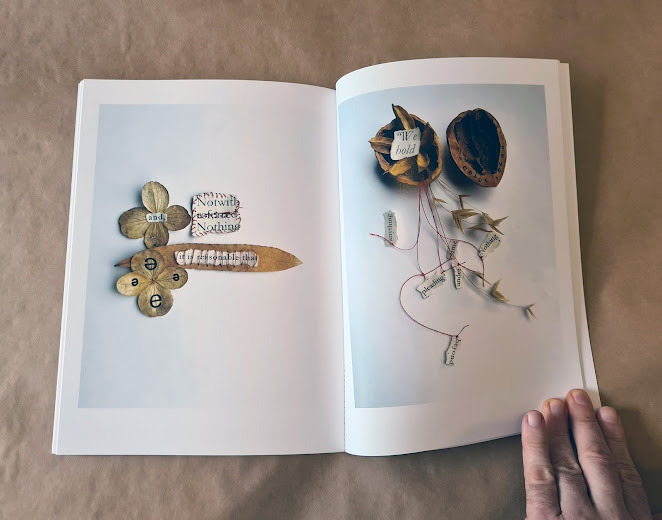
2. Kate Siklosi, leavings: Comprised of
seventy-three large full-colour photographs of visual poems comprised of a
combination of object (leaf, bark, branch) and text, is Toronto poet, editor
and publisher Kate Siklosi’s full-length debut, leavings (Malmö, Sweden:
Timglaset Editions, 2021). leavings is a collection of visual pieces composed
through a combination of printed text, visual poems and letraset combined with leaves,
twigs, branches and fir to reveal, in close detail, the physical interactions between
nature and language, and the impact of absolute brevity. In her piece “Hot and
Bothered: Or, How I Fell In and Out of Love With Poetic Conceptualism” at The
Puritan (posted May 1, 2017), she writes on “the trajectory of my personal love
affair with conceptualism” through looking at M. NourbeSe Philip’s Zong!
(The Mercury Press, 2008) and Jordan Abel’s Un/Inhabited (2014) and
Injun (2015), writing that “Sure, in some sense, it is ‘enough’ to screw around
with language and create art that floats inside a beautiful ether. But in the
face of the continuing projects of settler colonialism—to which we are all
subject, to lesser or greater degrees—I could no longer ignore the ways in
which authors consciously use and abuse poetic material in their work.” Through
such, she writes of both the requirements of properly acknowledging the materials
with which she works, as well as a deeper purpose than simply messing about
with language. As she writes: “in revealing the (mis)use and arbitrariness of
language, and of his-tory writ large, social activism and aesthetic praxis are
fused. Their poetic labour combines conceptualism’s interrogations of language
and symbolic representation with a persistent concern for equity and social
justice.” She writes of, as her endquote by bill bissett offers, a “shared fragility,”
as well as a particular kind of interconnectedness. One side of her work could
not exist at all without the other. See my full review here.

3. Gary Barwin and Tom Prime, Bird Arsonist: The second full-length collaboration by Hamilton
writer Gary Barwin and London, Ontario poet Tom Prime, following their
collaborative full-length debut, A CEMETERY FOR HOLES, poems by Tom Prime
and Gary Barwin (Guelph ON: Gordon Hill Press, 2019), is Bird Arsonist
(Vancouver BC: New Star Books, 2022). Noted in the press release as a collection
“[w]ritten with four hands,” Bird Arsonist is composed via short bursts
of language across a dense and surreal landscape of collaged and distorted words,
sound shapes and images. Twin-penned, one might say, and composed through the
one mind between them, Bird Arsonist displays a language of sound poetry
shaped to the page, writing poems that play with the distortions of meaning,
image and sound. There is such a delight displayed through these bursts of
speech, as the second half of the sixth and final poem in the sequence “Fair
Semiramis” reads: “Alphagetti skinhole / still-housed a mega-church /
crusty Hubble / the dictionary purrs / beards [.]” In certain ways, these poems
lean less into the layers of comparatively-pure surrealism of A CEMETERY FOR
HOLES, moving instead into a series of gestures of guttural speech, pushing
a surrealism wrapped around a playful, joyful sequence of contortions, cross-outs,
interruptions and explosions. “ate their hot facepalm / the hot-wired egg therein
// I ruddied / bandaged,” they write, to open to the poem “Prior Tongues,”
“the midnight feed-hole / compression bed / furtive, boiled as glands [.]” See
my full review here.
4. Sylvia Legris, Garden Physic: Saskatoon, Saskatchewan
poet Sylvia Legris’ latest is Garden Physic (New Directions, 2021), her
second full-length collection (and third title) to appear with American
publisher New Directions. Structured in four sections—“The Yard Wants What the
Yard Wants,” “Where Horsetail Intersects String,” “Floral Correspondences” and “De
materia Medicia”—Garden Physic is very much a space through which she
examines both botanical and the lyric through the lens of language, offering the
perspective of “the natural science that studies matter, its fundamental
constituents, its motion and behavior through space and time, and the related
entities of energy and force” (Wikipedia) on a space considered simultaneously
wild, natural and domestic: the garden. Legris explores the Latin names and
intimacies of plants, and there is something comparable to Toronto poet Kate
Siklosi’s recent leavings (Timglaset Editions, 2021) in a shared
approach to plant life on its own terms, from the opening poem of Legris’
collection, “Plants Reduced to the Idea of Plants,” that begins: “The flourish,
the fanfare, the febrifugic feverfew. // An oleaginous emplastrum—with horehound
leaf, / olive over olive, the oily parts, the dry. // An antidote for the
unblessed, the blistering, / the dourly flowering flora, the corpse flora. //
Greek turned Latin turned inordinately / angled and filed.” See my full review here.

5. Michael Trussler, Rare Sighting of a Guillotine on the Savannah: I’m
fascinated by the wide, slightly surreal narrative sweeps of Regina poet,
fiction writer and critic Michael Trussler’s latest poetry collection, Rare Sighting
of a Guillotine on the Savannah (Toronto ON: Mansfield Press, 2021). Trussler’s
Rare Sighting of a Guillotine on the Savannah offers a rush of expansive
lyric propelled by that which only poetry might allow, including ruminations on
what Leo Tolstoy might have thought of Marcel Proust’s In Search of Lost
Time, to sketches around Rothko and Agnes Martin, and his recollections around
the catastrophic eruption of Mt. St. Helen’s in May 1980. “I mean,” he writes,
as part of “The Birds Now Suddenly Vanished,” “metaphysics / aside, I dimly
remember // when Mt. St. Helens blew the day apart in Washington, but I didn’t
know / then how / lava covered // Harry Truman
and his 16 cats, his perfect bourbon / and coke, his lodge on Spirit Lake… [.]”
There is a curious layering effect Trussler employs in these poems, furthering
an expansive narrative that turns and twists, offering the poem’s possibility
through the sentence, as well as an interesting engagement with the ‘still life,’
exploring the narrative of the lyric to capture, possibly, the image of an idea.
“Incoherence being the thread that joins us.” he writes, to open the poem “Everything
Else is True.” In many ways, Trussler works his lyric as a form of exploratory
thinking, seeking out his theses and thoughts as each poem unfolds, writing from
a view that encompasses a wide range, from Saskatchewan rain to the Tokyo
Marathon, translation to visual art, lettuce and the inflection of a child’s
stomp. I’m enjoying the ease through which he shapes his explorations, shifting
from lyric couplets to prose shapes and sonnets, seemingly very comfortable
moving across form, including incorporating a variety of quoted texts to further
propel both his arguments and narratives. See my full review here.

6. Chantal Gibson, with/holding: poems: Award-winning
west coast poet, artist and educator Chantal Gibson’s second trade poetry
title, after How She Read (Qualicum Beach BC: Caitlin Press, 2019), is with/holding:
poems (Caitlin Press, 2021). Gibson’s engagement with shaping language is
clearly related to her experience as a visual artist, allowing visual elements and
aesthetics into the work that feel very different in texture and tone than the
directions that emerge out of concrete and visual poetries. As Hannah McGregor
offers as part of her blurb for the collection, “with/holding embeds the
reader in the flattening aesthetics of the internet, where every expression of
Black life is always already a meme waiting to be reprinted on a yoga mat.” These
are poems that unpack and respond to violence, racism, culture and history, and
the complexicities of depiction and representation. Gibson utilizes the structures
and dehumanizing trickery of online advertising to explore how Blackness is depicted,
dismissed and flattened in media, utilizing the language and structures of online
advertising copy to social media. Gibson’s work examines a distinct narrative
of corrosive speech built out of advertising and corporate language, one that
quickly collapses under its own altered meanings. “A white-collared Uncle Ben
will never look like / Obama,” she writes, early on in the collection, “and
light Aunt Jemima still looks like Auntie-Blackness. It’s hard, letting / go. Unless
it’s fixed to your head, a brown face is still blackface, no matter how / you
render it.” Through a compelling study shaped and formed in part through collage,
she writes of outliers and borders, writing of what has been erased, bordered,
boundaries and blacked out. “it’s the way she bites the heads off first,” she
writes, to open “Phobogensis,” “it’s the way she shows her teeth // it’s the
way she holds up each head // less body like a tiny black trophy be // tween
her pinchy-pink finger tips [.]” She includes a long sequence of white text in
black boxes, reframing a design shape of slogans. There is a sing-song quality
to her experiments and alterations, one that engages heavily with a play of
sound and visual propelled by intellectual rigor. See my full review here.

7. Ellie Sawatzky, None of This Belongs to Me: I’m enjoying
the lyric narratives in Vancouver poet Ellie Sawatzky’s full-length debut, None
of This Belongs to Me (Gibsons BC: Nightwood Editions, 2021), a collection
of small studies each articulating different elements of her ongoing attempts
to navigate and adapt to the various elements of entering the lived space of
adulthood. She writes of her aging parents to the unfolding of expanded expectations,
both from without and within. “In the silence now / we’re all adults and no one
knows // what’s best.” she writes, towards the end of the poem “RECALCULATING.”
Or the poem “COWHIDE, PLASTIC,” that includes: “How did I grow up and arrive //
here, of all places, and who are / these people with their cowhide // from Key
West, Pomeranian peeing / in the corner on plastic grass. Grown-ups // made me,
explained things like sex / and art and garbage.” Sawatzky’s poems are carved
portraits of thinking, less meditative than more immediately responsive to and within
the moment. From her home base of Vancouver, a city she has been in long enough
to have established roots, she writes of her shifting relationship to her hometown
of Kenora, Ontario, the introduction of two points requiring her to seek a new
sense of grounding between them. “My mother’s // voice in the smooth tunnel /
of the telephone. She’s alone // in the loft with her nine-patch / and oldies
channel. Hopeful // quilts on every wall,” she writes, to end the poem “I PRESS
AN EAR TO ONTARIO,” “and Lassie / bounding black and white // across the Scottish
Highlands.” See my full review here.

8. Zane Koss, Harbour Grids: From Canadian poet and
critic Zane Koss, following a small array of chapbooks, including two with
above/ground press, comes the full-length debut, Harbour Grids (Picton
ON: Invisible Publishing, 2022), a book of grids and landscapes writing out
topographical space as an expansion of virtual space, beginning with the
harbour beyond his Brooklyn window. As the cover copy offers, the collection
begins “as a phenomenological investigation of the surface of New York Harbor,
[as] this long poem radiates outward from Sunset Park in Brooklyn to explore
issues of labour, location, history, belonging, and subjectivity.” Harbour
Grids is composed as an expansiveness within set boundaries, as each page
is a grid of sixteen points, some of which are replaced through staccato, staggered
gestures of lyric. “the shipyards s set limits,” he writes, early on in
the collection. His use of the grid is structurally interesting, reminiscent of
the work of the late Edmonton poet Wilfred Watson (husband of novelist Sheila),
who worked a lyric exclusively composed via a modernist lyric shaped in grids,
or even an early title by George Bowering, his Points on the Grid (1963).
Koss’ exploration of visual space on the page is obviously informed in far different
ways than Watson’s explorations. “shoreline s obsured by construction,” he writes, two-thirds through the
collection. Koss writes out a sequence into the single sentence of the
collection, writing in constant, kinetic motion around labour and commerce, and
how they in turn shape the landscape, and thusly, its people. He composes a
meditation both visual and lyric, pointillist and staccato, accumulative and
stretched out as a singular line between regular points. See my full review here.

9. Sarah de Leeuw, lot: Prince George, British
Columbia poet and non-fiction writer Sarah de Leeuw’s creative work has long
been engaged with latitudes and longitudes, an ecopoetic attuned to specific
placings, markings and meanings, and she extends these engagements through her
newly-published long poem lot (Qualicum Beach BC: Caitlin Press, 2022). lot
is a book-length structure of accumulated bursts that explore and
articulate the relationships between land and place, and the people that live
there, composing a lyric formed out of carefully-spaced space, pauses, words
and short even staccato phrases. In a long poem on Haida Gwaii, renamed by
Europeans as the Queen Charlotte Islands, de Leeuw writes of lots, licenses and
paperwork, moving through land and history, and how external designations direct
the ways in which we interact with the land, from our depictions to our comprehensions.
She simultaneously manages a rush of lyric thought and the sense of one word carefully
and deliberately placed after another. As she writes, early on in the
collection: “Form a line / from first word to last. // Form a line / from right
to wrong. // Form a line / from left to right. // Form a line / from start to
end. // From dark to light. / From damp to dry. // Form a line / from one to
none.” There has been an interesting conversation around the poetics of space,
and the poetics of place, over the past two decades or so, shifting away from
what can be seen in hindsight as an exclusionary space of white settler-stretches,
evolving (one might say, finally) into a larger conversation that includes elements
of colonialism, race, privilege, occupation, original occupants and land
protectors. Writing adapts and responds to thinking, after all, and de Leeuw
attends to the multitude, and the polyphony of the land she occupies and how each
are framed. She understands, perhaps better than many, about the importance of
allowing those different perspectives to fully comprehend their impact upon
such geographies, as well as their people. See my full review here.

10. Daniel Sarah Karasik, Plenitude: Poems: Toronto writer
and organizer Daniel Sarah Karasik’s fifth book and second poetry collection,
following the full-length poetry debut, Hungry (Toronto ON: Cormorant Books,
2013), is Plenitude: Poems (Toronto ON: Book*hug, 2022). Composed as a collection
of urgencies, desires and reclamations, Plenitude is composed in six
sections—five sections of shorter lyrics and a long poem—and opening salvo, the
short lyric burst “messianic time.” As Karasik writes as part of the poem “radiant
incipience”: “when the police locked comrades / in the library and lied / about
it, our chant said / trans rights are human rights, / but what we meant
was / rights won’t save us / if we don’t protect each other.” Plenitude
offers a lyric attending to “our difficult present,” writing the imperils of police
brutality, anti-trans violence and of the possibilities of a body not held by gender
boundaries. In Plenitude, Karasik writes a lyric around gender, writing
into a sense and a self, including the political mechanisms of required resistance
to exist as a transgender person in the world, as well as the energies required,
and the exhaustions that would surely follow. “The poets have described the
world;” they write, to close the poem “Regarding the Prophetic Tradition,” “the
point, however is / to change / yourself into the kind of person / who can suss
out where the most / effective point of struggle is / and go there, or support
those / who are there already, on life’s side. / And to get free. Which is to
say, / to sing desire into a loving, / fighting sociality.” At turns the poems
are, as John Elizabeth Stintzi suggests via cover blurb, political, frisky,
personal and furious, as Karasik writes of being in the world as, by itself,
the purest act of resistance; a way through which to safely emerge and safely
love. See my full review here.

11. Mikko Harvey, Let The World Have You: The latest
from poet Mikko Harvey, following the full-length debut, Unstable Neighbourhood
Rabbit (Toronto ON: House of Anansi, 2018) and collaborative chapbooks Idaho
Falls (with Jake Bauer; SurVision Books, 2019) and SkyMall (with Ashley
Yang-Thompson; above/ground press, 2020), is the full-length Let The World Have
You (House of Anansi, 2022). A Canadian poet living in Western Massachusetts,
Harvey predominantly composes poems in first person lyric narratives that float
across the boundaries of concrete image. “Wherever you are is a country.” he writes,
at the mid-point of “Wind-Related Ripple in the Wheatfield,” “Touch it softly /
to make it stand still. Your hair getting caught / in my mouth all the time,
like a tiny piece / of you calling – like a tree trying to speak / to a rock by
dropping a pinecone on it. / It is my intention to listen, but my hands / keep
giggling while reminding me / I don’t get to be a human being / for very long,
as if this were the punchline to a joke / whose first half I missed. I arrived
too late.” There is an odd melancholy throughout, and Harvey’s is a lyric of
held breath, and structurally echo a loose thread of lyric narratives I’ve seen
over the past few years from American poets including Bianca Stone, Hailey
Higdon, Hillary Gravendyk, Emily Kendal Frey and Emily Pettit: sharing a consideration
for long, single stanzas, and their subversion of the short phrase. “I don’t /
want you / to be / nervous.” He writes, to open the poem “For M,” “Maybe /
thinking of / a walrus / would help.” See my full review here.

12. Laurie D. Graham, Fast Commute: Toronto poet
and editor Laurie D. Graham’s third full-length poetry title, after Rove (Regina
SK: Hagios Press, 2013) and Settler Education (Toronto ON: McClelland and
Stewart, 2016), is Fast Commute (McClelland and Stewart, 2022). Much
like Toronto poet Phoebe Wang’s simultaneously-published Waking Occupations
(McClelland and Stewart, 2022), Fast Commute attempts to come to terms
with our colonial past and present, viewed through an ecological lens—two elements
clearly intertwined and impossible to separate—something her work has been
engaged with for some time. “Cities joined,” she writes, early on in the collection,
“though separated by rivers, / cities twinned by growth, tension nested in the
hyphen [.]” Set as a long poem through short, collaged sections, introduced by
a self-contained opening salvo, there are structural echoes of Don McKay’s
infamous Long Sault (London ON: Applegarth Follies, 1975) through her narrative
layerings, historical asides and attentions to landscape. “Knowledge of home in
danger of becoming academic.” she offers. “An empty can of energy drink under a
sugar maple. / A black squirrel crossing critical thresholds: // roadwall, greenstrip,
chainlink, trail, wooden fence, property.” She writes on refineries and tearing
resources from the eroding landscape, citing settler histories and occupation, and
the ways in which these opposing thoughts can’t help but find conflict. See my full review here.

13. Phoebe Wang, Waking Occupations: Toronto poet,
writer and educator Phoebe Wang’s second full-length poetry title, after Admission
Requirements (Toronto ON: McClelland and Stewart, 2017), is Waking
Occupations (McClelland and Stewart, 2022). Much like Toronto poet and
editor Laurie D. Graham’s simultaneously-published Fast Commute (McClelland
and Stewart, 2022), Waking Occupations attempts to come to terms with
our colonial past and present, writing, as the back cover offers, a “meditation
on what it means to live on colonial land and in colonial time, [as] the subject
of these poems has moved beyond arriving and departing. It follows the figure of
the artist at a time-travelling woman, embodied by mother and daughter, through
the gallery of memory.” Waking Occupations is composed in four sections
with an opening salvo, and I’m intrigued by the slow, narrative moments of her
lyrics, comparable to frost across a window: how her poems appear to begin at a
single, small point and slowly stretch out. As the poems in the first section
speak to that unease, and uncertainty, the poems in the second section respond
more overtly to specific portraitures, still lives and sculptures, utilizing museum-pieces
as a prompt for a series of meditations on culture, memory, personal history
and attention. As she offers, as part of the extended poem “STILL LIVES”: “Mom’s
forehead is dense as granite // as she knits to the end of the row, turns it,
starts again. / She too makes good use of discards / and sticky materials, //
of a lower set of standards. / She switches between vehemence and doubt, /
insisting that anything worth doing is worth doing well.” Through the third section,
she writes on brief encounters with a variety of household artefacts, from
plastic slippers to a lacquered bowl, straw sandals and stovelight, highlighting
elements of domesticity, antiquity, displaced cultures and colonialism. There’s
an enormous amount going on in Wang’s lyric, threads that run through the
entirety of the collection around the colonial past and continued present, on
cultural divides and depictions through an array of approaches through visual
art and colonial exploration. Her poems seek to acknowledge the moments and monuments
constructed as ways to erase another, no longer passive but as actively
witnessing, as a means to then confront the present. See my full review here.

14. Jim Johnstone, Infinity Network: Toronto poet,
editor and publisher Jim Johnstone’s sixth full-length poetry title is Infinity
Network (Montreal QC: Signal Editions/Vehicule Press, 2022), a book that works
to articulate elements of violence that ripple beneath the skin of culture; the
ways in which infinity turns on itself and consumes its own tail, writing the
ouroboros of deleted scenes, dehumanizing corporate culture and the echo
chambers of social media, amid strains of isolation, self-harm and truthiness. “The
problem is permission,” he writes, to open the poem “Trompe L’Oeil,” “and I told
you / I don’t like to be touched. // The problem is / self-harm— // knuckles aligned
to read: / HATE / LOVE.” There are long threads being composed by Johnstone
through this collection, with his individual pieces and longer stretches feeling
akin to a narrative shorthand, able to see the trees for the forest, but also
the larger picture of how each of these different elements cohere into something
larger, connecting the world to all that live within it. “Sober again. Don’t listen
to me,” he writes, as part of the fifth in the ten-poem sequence “Deleted
Scenes,” “in this state. // Conscious enough to develop / fever, blister from sheer
depravity.” He writes as a pragmatist, or even an optimist, but one who aims to
shine a light in dark places. Or, as he writes to end the poem “Identity as a
Wormhole in a Hotel Window,” “One day everyone / who rents a room in this town
will be different.” See my full review here.

15. Matthew James Weigel, Whitemud Walking: Last year, I was
introduced to the work of “Edmonton-born and -based Dene and Métis poet and
artist” Matthew James Weigel through his bpNichol Chapbook Award-winning It
Was Treaty/It Was Me (Montreal QC: Vallum Chapbooks, 2020), a title that was
an excerpt of his larger, expansive reclamation and archival project, Whitemud
Walking (Toronto ON: Coach House Books, 2022). Structured as a single,
book-length project, Weigel works through the archive, researching and discovering
elements of his family’s personal history within government and university
archives, to attempt to articulate a colonial past and present. Through his thoughtful and careful assemblage
of altered image and text, the collection answers the unasked question that
runs across the length of the project: who gets to tell the story of one’s own
family? As the back cover of the chapbook offered: “Drawing on government records,
archival images and his own family history, Matthew James Weigel blends prose
and poetry to look how John A. Macdonald and his government used to treaties to
dispossess Indigenous peoples of their lands. Weigel juxtaposes the machinations
of the Canadian government with other versions of the story; official history
bumps up against memories recorded in the body, exposing corruption and violence.”
Through Whitemud Walking, he offers the archive as a simultaneously deeply
personal and impersonal space, attempting to reconcile his family histories against
the colonial dislocations these same documents broadcast. Through these
documents, and this full-length debut, Weigel’s “documentary poetics” (as
Dorothy Livesay coined it) engages what might otherwise be seen as distant
materials of the archive, opening up a far deeper and broadly personal examination
of colonialism, threads of history and cultural belonging. See my full review here.

16. Madhur Anand, Parasitic Oscillations: The second trade
poetry collection and third book by Guelph, Ontario writer Madhur Anand,
following the poetry debut A New Index for Predicting Catastrophes
(Toronto ON: McClelland and Stewart, 2015) and the Governor General’s
Award-winning experimental memoir, This Red Line Goes Straight to Your Heart
(McClelland and Stewart, 2020), is Parasitic Oscillations (McClelland
and Stewart, 2022). There are echoes of structure and concern throughout the
spring 2022 quartet of McClelland and Stewart poetry titles, from the
ecological drift through colonial land and colonial time of Laurie D. Graham’s
simultaneously-published Fast Commute and Phoebe Wang’s Waking
Occupations, and the ecological birdsong of Tolu Oloruntoba’s Each One A
Furnace. Anand offers the beauty of birdsong and ecological concern among
and through a veil of scientific inquiry, shades of family detail and poetic
language. “Human speech is a subsong of trachea / and beak.” she writes, as
part of the short poem “A SIMPLE NOTE.” “It is illustrated in this letter how
// pressure will control not only strength but also sound. / It is expected
there be some overlap, tension // while mimicking lexicon, emphasis on power.” Writing
a collage of image, sound, research and speech, hers is a book of counterpoints,
compassions and compressions, moving between and amid terminologies and
alternate viewpoints, museum pieces and historical artifacts. “Every line of
thought / is an oscillation we must enter / into arbitrarily,” she writes, to
open the poem “MIND COMPRESSION,” “Only this small amount / of work in a vacuum
/ and it all makes sense // We are bound to equating / contradictions of
experience / with experience [.]” See my full review here.

17. Andrew Faulkner, Heady Bloom: Picton,
Ontario poet Andrew Faulkner’s second trade poetry collection, after Need
Machine (Toronto ON: Coach House Books, 2013), is the remarkable Heady
Bloom (Coach House Books, 2022), a book of meditations and conversations
around headaches and pain relief, writing on Advil while offering classical
references amid dense language and deft turns. “From spit and straw,” he
writes, as part of the poem “WHAT ADVIL GETS UP TO,” “Advil assembles / amphetamine’s
scarecrow cousin. // Advil sucks its teeth as it thinks. // Advil is thick, / as
always Advil is thick, / with representation.” Heady Bloom writes a poetic
response across headaches, as the opening poem, “ON VISIONS,” offers, further
on: “The sensation / could be a headache only. // To obsess is a mistake. /
What’s not to believe? Suffering // and ascendance require the same work. / The
literature is clear: these things / happen all the time. // One is advised not
to argue / with the extraordinary persistence of vision.” I deeply admire the
way through which Faulkner engages semi-familiar and familiar facts and
references to write unexpected corners, akin to Tom Stoppard writing the spaces
only he could see through Shakespeare’s Hamlet to compose his infamous play
Rosencrantz and Guildenstern are Dead (1966). Through composing
reflective passages on facts and truth, and the slippages of what both of those
have become and might be, there are echoes of tone throughout reminiscent of
works by Stephen Brockwell and David O’Meara; I could imagine either one of those
Ottawa poets offering a lyric similar to the one that ends Faulkner’s poem “GUNS
N’ ROSES PINBALL MACHINE”: “The game darkens the depot // like a sweetly
blackened eye. / Skin discolours where blood convenes. // It's not quite pleasing.
But whither the fun / in a jungle of leaving.” See my full review here.

18. Gillian Sze, quiet night think: poems & essays: I’m fascinated
by the way Montreal poet Gillian Sze weaves poetry, memoir and essay in her
latest collection, quiet night think: poems & essays (Toronto ON:
ECW Press, 2022). The author of nearly a dozen poetry titles and three picture
books, Sze’s quiet night think is a book of meditations though the lyric,
writing on language, translation, poetry and becoming, writing out the slant
ways she came to writing, and the construction, or even the capability, of a
more comfortable and complete version of herself through the process. It is
interesting to hear how her sense of language, culture and writing emerge from
the same central core, prompting her before she was even conscious of how each might
have been affecting her. Very much composed and organized as a book of origins,
quiet night think is constructed through a blend of memoir, essay, prose
poem and lyric; as the press release offers: “six personal essays, poems, and a
concluding long poem” composed by “a new mother, contemplating her own origins,
both familial and artistic.” Threading through form, Sze allows the ebb and
flow of the personal essay and the prose poem to explore far more than perhaps the
single possibility of structure and form might have allowed. She writes of how
her name became her body, and answers the interweave of “how she got here”
through the lens of her family origins and history, existing through and
between two languages and cultures, and the ways in which new motherhood simultaneously
shifted, expanded and validated her perspectives on all of the above. See my full review here.

19. Nancy Holmes, Arborophobia: I was curious to see the
latest by Okanagan, British Columbia poet Nancy Holmes, her Arborophobia
(Edmonton AB: University of Alberta Press, 2022), given my recollections of my
earlier days exploring contemporary poetry, and how much I enjoyed her second
collection, not long after it originally appeared. Arborophobia is made
up of a series of narrative, meditative lyric on trees and dementia, loss and
falling, mothers and motherhood, grief and erosion. Holmes writes of breakings,
and of breaking apart, from climate to forests to the human ability to endure. “They
say everyone eventually / gets dementia.” she writes, to open the poem “MEAT.” “We
/ flip through crosswords / and eat too much beef.” She speaks of time, and the
measure, misuse, misunderstanding and even limitations of such a human scale. “Of
course you want more.” she writes, as part of the twelve-part sequence “THE
TIME BEING,” “But truly, you can’t / fit any more into your life.” Through
long, narrative stretches, she offers poems as companion pieces to climate
anxiety, personal loss and the uncertainty of where we sit as a species, thanks
in large part due to an array of choices both historic and ongoing. See my full
review here.

20. Ayaz Pirani, How Beautiful People Are: a pothi: Ayaz Pirani’s
third full-length poetry title, following Happy You Are Here (Washington
DC: The Word Works, 2016) and Kabir’s Jacket Has a Thousand Pockets (Toronto
ON: Mawenzi House, 2019) is How Beautiful People Are: a pothi (Guelph
ON: Gordon Hill Press, 2022), a collection of lyric poems structured across four
titled sections, three of which are predominantly built out of shorter poems—“BELOVED
INFIDEL,” “DEATH TO AMERICA,” the sequence “(WHITE) CITY | KID (TROPIC” and “KABIR’S
LONELINESS.” The back cover offers that Pirani, through this new collection, “continues
to write his people’s pothi: a trans-national, inter-generational poetry of post-colonial
love and loss animated by the syncretizing figure of Kabir and drawn from the
extraordinary diwan of ginan and granth literature.” From my own limited
experience around poetries in languages beyond English, Pirani’s poems seem
echoes of what I’ve seen of the English-language adaptation of the ghazal,
bouncing from moment to moment underneath an umbrella of narrative, and not through
the overt, linear thread. His is a lyric predominantly constructed through couplets,
but one that allows for the mutability and durability of the lyric; an
exploration that understands the simplicity and the complexity of the first-person
narrative line, and the underlying song that the lyric itself requires. See
my full review here.
.jpg)
21. Catriona Strang, Unfuckable Lardass: Poems: The latest
from Vancouver poet Catriona Strang, following Low Fancy (Toronto ON:
ECW Press, 1993) Busted (with Nancy Shaw; Toronto ON: Coach House Press,
2001), Light Sweet Crude (with Nancy Shaw; Vancouver BC: Line Books, 2008),
Corked (Vancouver BC: Talonbooks, 2014), and Reveries of a Solitary Biker
(Talonbooks, 2017), is Unfuckable Lardass: Poems (Talonbooks, 2022), a
collection that “began as an attempt to refract and undercut an outrageous insult
allegedly lobbed at German Chancellor Angela Merkel; as such, Unfuckable Lardass
is fuelled by the energy of grief and rage, counterpoised by moments of love
and hope.” She begins with a response and a rage through a language that lobbies,
parries and bounces across the rhythms of lines and breaks into responses to
the patriarchy, parenthood and the slow loss of her parents: “some storied
youth / that was not / my mother, gone,” she writes, as part of the opening
sequence. There is such music to her cadence, and she writes a lyric of
rebellion, resistance and response. “picking myself apart,” she offers, as part
of the second sequence-section, “rapts all part’s lift / and flicks curious
reflection; / let’s slough off all / peaks, my peaks / give flex to too many / scurrilous
scrapings / to reach this / sure reef’s shore [.]” Referencing George Bowering,
Ted Byrne and Fred Wah (with the unspoken echoes that suggest threads of early
Sharon Thesen, Lisa Robertson and multiple others), Strang composes a lyric deeply
influenced by a west coast poetics that runs through a Kootenay School of
Writing chaser back to a TISH language bounce and parry down the page via
a collision of sound and meaning. See my full review here.

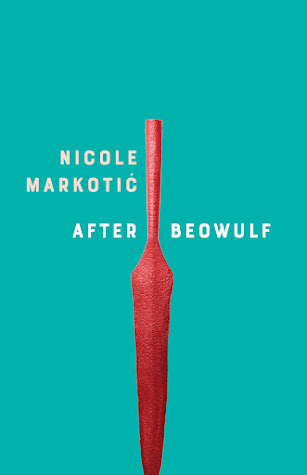
22. Nicole Markotić, After Beowulf: Windsor,
Ontario-based poet, editor, writer and critic Nicole Markotić’s latest
full-length poetry title is After Beowulf (Toronto ON: Coach House
Books, 2022), a book of simultaneous translation, transelation (as Moure
coined it, via her 2001 Anansi title, Sheep’s Vigil by a Fervent Person)
and reimagining of the classic Old English poem Beowulf (c. 700-1000 AD),
rifling through a myriad of forms as a way through her own reading of an
ancient poem imagined, interpreted and reimagined from Seamus Heaney’s translation
to an episode of Star Trek: Voyageur. Reworking one of the earliest of
epic poems through English and Danish traditions, there is a swagger to Markotić’s
lyric, one propelled by both character and the language, writing a collage of
sound and meaning, gymnastic in its application and collision. As is well-known,
the old stories adapt themselves to our requirements, and update to meet and
suit us [see also: my review of Helen Hajnoczky’s Frost & Pollen,
which includes a reworking of The Green Knight], and Markotić works her
assembling of language, lyric and permeations of English into a kind of
Frankenstein’s Monster, stitching together scraps from a variety of prior adaptations,
and a language-hybrid that blends contemporary banter with Old English. “Herewith
trespasses / Grendel – no introduction – breaks into / the Introduction,” she
writes, early on in the collection, “foul foundling, heaping with narrative
potential / (contrast: that ‘one good king’ / repeating line, colossus-driven) /
his celebmentia gains real estate / then fades to black, fades / into macabre
backstory.” See my full review here.

23. Arleen Paré, Time Out of Time: I was curious
to see Victoria, British Columbia poet Arleen Paré’s latest collection, Time
Out of Time (Qualicum Beach BC: Dagger Editions/Caitlin Press, 2022), a
collection that takes as its immediate prompt of a particular work by the late
Lebanese-American poet Etel Adnan (1925-2021). As Paré writes as part of a “Note
from the Author” to open the collection: “In April, my poet friend Maureen
Hynes suggested I read Time by Etel Adnan. It was love at first page. The
poems in Time are spare and exquisitely structured. And then I discovered
the remarkable Etel Adnan herself! […] In 2020, Time won the Griffin
Poetry Prize. Fully smitten, I have employed the poetics in Time to
shape this tribute collection.” There’s something not only ambitious but
ultimately daring in declaring one’s intentions at the offset: any reader could
easily move to the source material and ultimately compare the two. Some things
can’t be helped, I suppose. And while Paré isn’t Adnan (nor is she, through
this collection, aiming or claiming to be), the shift in her own work through
this collection is interesting: composed from the place where her interest and
Adnan’s meet, and expanding upon those possibilities of influence. “This is
what a blessing is,” Paré writes, to open the poem “A Blessing,” set
between poems “33” and “34,” “forty years
waking up every morning side by side / leaving the house through the front
door enduring so little a blessing [.]” See my full review here.

24. Prathna Lor, Emanations: Poems: The full-length
debut by Prathna Lor, following the chapbooks Ventriloquism (Future
Tense Books, 2010) and 7, 2 (knife│fork│book, 2019), is Emanations:
Poems (Hamilton ON: Buckrider Books/Wolsak and Wynn, 2022). Emanations is
constructed as a triptych of suites—“ON SEVERAL SERENADES FOR BENEVOLENCE,” “RED
BEACON” and “PEDAGOGY OF RIDICULOUSNESS”—each assembled as accumulations of
lyric fragments, halts and hesitations stretching the boundaries of narrative and
connective tissue, moving forward without clear endings or closures. “Think
like a painting.” Lor writes, to open the second section. There is such an
openness to Lor’s ongoing, meditative lyric, one that wrestles simultaneously
with spirituality, self-determination and the boundaries of commodification. Lor
writes across the contours of self-creation and discovery, articulating values
of both the collective and the personal, and the ways through which so much is
lost through commodification. “How a poem / never lies,” the second section
offers, “only / dilutes what is given to speak / what is given to breath [.]”
Later on, in the same sequence-section: “And there you are thinking light / an
incomplete fabrication / moved by a pronoun / I am living, finally, / because I
learned the death in the line [.]” Lor’s lyric presents a metaphysics of concrete
language, writing out the nuts and bolts of the space where language speaks,
and not only informs but holds meaning. “You can dream in another tense.” Lor
writes, as part of the second section. See my full review here.

25. Annharte, Miskwagoode: The fifth full-length
poetry collection from Anishinaabe poet Annharte, a/k/a Marie Baker, is Miskwagoode
(Vancouver BC: New Star Books, 2022), a collection composed against a backdrop
of loss: “Taken from the Anishinaabe for ‘woman wearing red,’ Miskwagoode
is an unsettling portrayal of unreconciled Indigenous experience under
colonialism, past and present.” Across a layering of shifting form, Annharte’s Miskwagoode
offers a collision and cadence of words that flow across possibilities, writing
of violence, grief and addiction, and the loss of so many through the legacy of
colonial trauma. “where goes this naked ndn // not born Indigenous without,”
she writes, as part of “Jack Identity,” “blue mark on bum // fail to act
indifferent // national inquiries hold on [.]” The poems explore form, identity,
community and “a backdrop of unreconciled realities within Indigenous experience,”
from prose bursts to poems set as layered accumulations of staccato phrases,
all set as disjointed descriptives across a documentary poetics she’s been crafting
for years. “explain what is possible,” she writes, to open the poem “Better Yet
Explain,” “for right now create / street surveillance position / post
qualifications / employ non-gloved hand / feel out resistance / anticipate
interference / from driven class interests / encourage cultural revival /
lessen neo-liberal outreach [.]” And, as much as she presents herself as the
documentarian, she sits precisely within the scope of her poems; more than simply
an observer, she offers commentary, advice and option, neither passive nor
unbiased, but deeply invested what is happening, and what should be happening;
the ways in which things need to improve, both from without and from within. One
might claim this, in the end, a book of deep grief and honesty, and how healing
(and reconciliation) can only emerge through a true acknowledgment of the devastation
wrought through colonialism. Moving her lyric across a landscape of mourning, the
tone of her poems shift slightly in the final section, “Wabang,” through a
suite of poems composed as prose declarations, and even calls-to-action. The poems
are hopeful, engaged with a playful wit and gymnastic cadence, composing a
blend of sound and storytelling to provide something to hold and hold on to. See
my full review here.

26. Nanci Lee, Hsin: It took a few days to
begin to write out my notes on the full-length poetry debut by Nova Scotian
poet Nanci Lee, her Hsin (Kingston ON: Brick Books, 2022), given the
prompts it generated in my own thinking around adoption and identity,
especially based on information garnered over the past two years through multiple
genetic connectors (but enough about that). The poems of Hsin fragment,
collect and pool across a wide stretch of narrative and meditative lyric,
composed as a way to situate, navigating adoption, and seeking to connect properly
to her disjointed cultural threads and elements of family. “It’s been decades.”
she writes. “I can imagine that you, / too, must have had a full life.” Structured
in three sections—“Who are you?,” “What do you obey?” and “How will you prepare
for your death?” she writes from a very specific prompt, seeking resolution,
clarification and the ways through which the proper questions might emerge. She
seeks clarification on questions that have been building across the length and
breadth of her life, some of which might never find the answers she seeks, in
the forms she might seek them. In certain ways, this is a collection of poems
composed around and on the very idea of silence (reminiscent, through that
singular element, of Nicole Markotić’s debut novel). “My birth / mother found
me decades later,” Lee offers, “only to lose her own mom. This was / a sign,
she was sure of it. The gods made her a trade for silence.” See my full review
here.

27. kevin mcpherson eckhoff, The Pain Itself: In certain
ways, one could see the whole of British Columbia poet and editor kevin mcpherson
eckhoff’s ongoing work as a series of explorations into refreshing perspective
through language, seeking new ways to explore how language shapes, distorts,
refreshes and recreates meaning. Working through very much an engagement with what
the late Toronto poet bpNichol referred to as “serious play,” he’s produced an
enormous amount of oddball works over the past fifteen years, including the
full-length collections rhapsodomancy (Coach House Books, 2010), easy
peasy (Snare Books, 2011), Forge (Invisible Publishing, 2013) and Their
Biography: an organism of relationships (Book*hug, 2015), as well as a wealth
of chapbooks, including Document One (Martian Press, 2006), Channeling
Voices (ungovernable press, 2008), Game Show Reversed (Book*hug,
2010), dissections from their biography (above/ground press, 2012), faux
foe (above/ground press, 2018), Circadia (Gaspereau Press, 2018), an
excerpt from BABYLON AD PROPHECY (serif of Nottingham, 2019) and dieting
Herb Wit (above/ground press, 2020). His latest work is The Pain Itself,
a book composed as a translation into a placeholder language as an experiment
in translated meaning. eckhoff has long been engaged in the possibilities of
meaning that emerge through manipulated texts, composing works through unexpected
turns, gyrations and inexplicable connections, and The Pain Itself pushes
the collision of words and phrases into an area that not only allows for but is
purposely constructed to embrace the unexpected, and even nonsensical. Call this,
perhaps, a “Translating translating Cicero,” if you will, as a project entirely
centred around play and surprise, and a new way of phrasing and other
possibilities of meaning. A new way of phrasing, one could argue, leads into new
possibilities of perception, and of thinking, all of which is entirely dependent
upon meaning, as opposed to simply dismantling it. To paraphrase
Vancouver poet Meredith Quartermain, words can’t help but mean. See
my full review here.

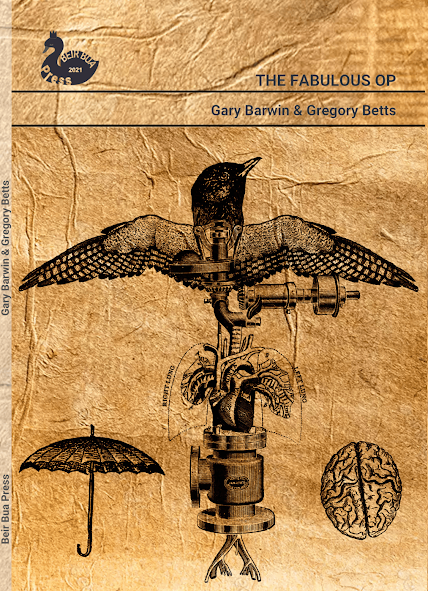
28. Gary Barwin and Gregory Betts, The Fabulous Op: I’ve been
eager to explore titles from Beir Bua Press, an Irish publisher that appeared
to emerge out of nowhere a short while back, and seemingly publishing stellar
works of experimental writing from the get-go; the first of their titles I’ve
managed to get my hands on is Hamilton writer Gary Barwin and St. Catharine’s,
Ontario writer Gregory Betts’ collaborative The Fabulous Op (April
2022), a book of collaborative play, response and experiment through a bleed of
text and image. “re new / re new grief / re language rising / re broken laugh /
re always,” they write, mid-way through the collection, “recomposing / as what
you / riot / you art [.]” Barwin’s collaborative explorations have become more
prevalent over the past few years, although he’s been working in the form for
some time, and this particular collection seems an extension of their previous
collaborative effort, The Obvious Flap (Toronto ON: Book*hug, 2011). Through
the pieces of The Fabulous Op, Barwin and Betts offer twists of anagrammatic
text and puns, texts shaped and re-formed as image, and images recombined and
reconstituted, blending shifts and structures and expectation. There are ways
in which their explorations of visual and sound exist almost prior to any
consideration of meaning, less tethered to the possibilities of how words and
images form meaning than the sense that their collage-suites of visual and
aural explorations might provide. While their medium might heavily include
language, one might attempt to seek meaning from their explorations in the same
way one might seek similar from the paintings of Roy Kiyooka, an album by Dave
Brubek or a recorded performance by either The Four Horsemen or the Nihilist Spasm
Band. The expectations of how one reads becomes important. Flip through the
collection, and catch what they are doing. Can you see what they’re doing? See my full review here.

29. Ivan Drury, Un: From BC-based editor and
writer Ivan Drury comes the full-length debut, Un (Vancouver BC: Talonbooks,
2022), a book titled through a curious echo (for certain readers, at least) back
to Toronto poet Dennis Lee’s own poetry title of the same name, published by Anansi
in 2003. Where Lee offered his Un as the first step in a two-volume
bookend around an undefinable space, Drury composes a language-lyric to acknowledge
the lost, dismissed, overlooked and disappeared, writing the negative space
around an ongoing colonial occupation. “I am casting off from Canada in search
of un,” he writes, early on in the collection, as part of the poem “Chainlink’d,”
“as though my recognition could be a cure [.]” Drury’s Un writes a lyric
of trauma and witness, accessing elements of lyric and language writing,
allowing a musicality that also offers echoes of the poetic structures of such
as Jeff Derksen, Renée Sarojini Saklikar or Danielle Lafrance. “the spectre of
apocalypse / has no folk songs,” he writes, as part of “The Spectre of
Apocalypse,” “has poems only to remember / and organize genocide // has martyrs
only to apocalypse // has no Victor Jara / to conduct handless the detained
thousands / and raise soulful song / against fascism [.]” He writes of the US “War
on Terror” and the disappeared, from America through the Middle East to North
Africa, writing the spaces around what is impossibly silent, unknowable and
numb. Offering theory, poverty and politics through language, Drury’s is a documentary
poetics, one propelled by an insistence upon acting as witness, reminiscent of
contemporary titles such as Layli Long Soldier’s Whereas (Graywolf,
2017) or Cecily Nicholson’s From the Poplars (Vancouver BC: Talonbooks,
2014). “this new Canada is at once academic and trrrrtrrrrial,” he writes, as
part of the sequence “K. to the Prison of Grass,” “hard at the edges and marrow
where the lives meet the days // pungent grey marrow // at the joints of these
bones is / the lubrication of grinding contact [.]” See my full review here.

30. Qorbanot: Poems by Alisha Kaplan; Art by Tobi Aaron Kahn:
I
was curious to see poet Alisha Kaplan’s name on this past year’s Gerald Lampert
Memorial Prize shortlist for the collection Qorbanot: Poems by Alisha
Kaplan; Art by Tobi Aaron Kahn (Albany NY: State University of New York
Press, 2021), having neither heard of the author (who divides her time between
Toronto and Hillsburgh, Ontario) nor the publisher prior to that shortlist announcement
(the book subsequently won this year’s award). Titled after the Hebrew word for
“sacrificial offerings,” Qorbanot exists as a paired examination of how
words and image simultaneously hold and contain memory, history, hope and
trauma. The paired threads of text and visuals are set in seven numbered
sections, collected and ordered brilliantly to fully adhere to a conversation
between works by two separate artists, from the “studies” of painter Kahn—“Study
for YMNAH,” “Study for VEIKUT,” “Study for EIKA” and “Study
for AKYLA”—counterpointing the “offerings” by poet Kaplan (a number of
titles of which repeat through the collection)—“Guilt Offering,” “Peace
Offering,” “Masada Offering” and “Offering to the Lost Poet Rosemary Tonks.” The
works included and enclosed speak of loss, and possibilities extinguished, as
well as those that might still remain. This is a remarkable collection, one that
opens, uniquely for a new poetry title, with a foreward by James E. Young, and
closing essays by Kaplan, as well as Ezra Cappell, Lori Hope Lefkovitz and Sasha
Pimentel. It is as though the creative sequence of call-and-response by Kaplan
and Kahn exist as a foundation of study, and the supplemental pieces that surround
this powerful and unique collaboative conversation exist to provide a fuller
portrait of their work, and everything that surrounds it. See my full review
here.

31. Stephen Brockwell, Immune To The Sacred: The latest
from Ottawa poet and editor Stephen Brockwell is the full-length Immune To
The Sacred (Mansfield Press, 2022), his seventh full-length poetry collection
overall, following The Wire in Fences (Balmuir Poetry Series, 1988), Cometology
(ECW Press, 2001), Fruitfly Geographic (ECW Press, 2004), The Real
Made Up (ECW Press, 2007), Complete Surprising Fragments of Impossible
Books (Mansfield Press, 2013) and All of Us, Reticent, Here, Together
(Mansfield Press, 2016), as well as numerous chapbooks. Composed as contained
bursts of passionate deduction, Brockwell’s lyric theses offer a scientific approach,
one that seeks out the promise of pure facts, yet hold a high regard for the
possibility of wonder. “Look,” he writes, to open the poem “MIRACLES OF THE
SACRED REPLACEMENTS,” “my terrier puppy bears wings. / Each morning, my tabby
sings arias for kibble.” His is a lyric simultaneously aware of both the lyric complexities
and possibilities of corporate-speak, and how, as his late mentor, the poet
Peter Van Toorn once wrote (Brockwell offers a dedication to Van Toorn at the
end of the book’s acknowledgments), “you can smell the poem in a thing for
miles.” Despite this, Brockwell’s lyric holds a discomfort, one fully
self-aware, as though he ponders this unique placement and perspective, with a
foot each in two worlds of perceived separate thinking, each of which consider
the other utterly foreign. Instead, through Brockwell, the two sides appear intricately
connected: if one is to think through language, after all, there will always be
an opening into and through poetry. Through Immune To The Sacred, Brockwell’s
poems have shifted from one seeking to articulate the artifice, as well as the shaped
perceptions, of cultural and intellectual constructions, into a lyric engaged
with attempting to get, finally, at and into the root of a lived engagement
with the world as it is. To open the poem “WHY YOU CAN’T HAVE BEAUTIFUL THINGS,”
he offers: “Here is a beautiful thing: a cuttlefish tattoos itself the mottle /
sepia of the reef. // Here is a beautiful thing: the tardigrade clambers up a /
ladder of algae.” See my full review here.

32. Tasnuva Hayden, An Orchid Astronomy: Calgary-based Tasnuva
Hayden’s full-length poetry debut is An Orchid Astronomy (Calgary AB:
University of Calgary Press, 2022), a book-length narrative around “the story
of Sophie, of her personal collapse and of climate catastrophe, told in
striking experimental poetry.” The back cover writes that “Sophie grew up in
Veslefjord, deep in the Norwegian North, where the ice stretches to the horizon
and the long polar night is filled with stories about the animals of the sea,
ice, and sky. Now the ice is melting and the animals are dying. Sophie’s mother
is also dead, leaving behind a daughter and a lover on the melting permafrost.”
Hayden composes her Orchid as a sequence of lyric pinpoints, lines set as
constellation across the page, linking stars to further starts to form her images,
her stories; enough to hold the world together, simultaneously brief and
sketched and across the vastness of narrative time. Through An Orchid
Astronomy, Hayden has composed fifteen poems of varying length, breadth and
scope, most of which are named for constellations, as well as occasional stars
and other celestial offerings. Ranging from lengthier stretches to short,
scattered bursts, the structure of the collection is held by a narrative
through-line writing itself across a tension of expanding-and-contracting lyric.
“What is civilization without / literature?” she asks, early on in the
collection. “From the windows, watching stars. / Sand sugared across shoulders.
// Hands or hooves?” See my full review here.

33. Naturalism, An Annotated Bibliography: Poems by Michael Goodfellow: I’m fascinated by the single, staggered, unbroken sentence of
Lunenberg County, Nova Scotia poet Michael Goodfellow’s surefooted lyric as displayed
in his full-length debut, Naturalism, An Annotated Bibliography: Poems (Kentville
NS: Gaspereau Press, 2022). Through an assemblage, nearly a suite, of short
poems, Goodfellow offers a descriptive layering of landscape across the connective
tissue of his self-described “small waterfront acre,” rippling slowly out from
that central, singular focal point of roots, observation and interaction. He writes
of home and his landscape, offering a lyric of the right words in the right
order, and a tangible and concrete poetics of light across the water, the movement
of human culture and sunsets, beaches and sullen hillsides. “The moon rose
behind us,” he writes, as part of the poem “HIRTLE’S BEACH METONYMY,” “an animal
// staring out the brush. / The thick, you called it. // You had other words for
things, / you tongued them out, letting them shape // in the air, then dampen:
/ sand the colour of bark, // how night was the green of a burnt forest, / how
years leaf-out loss, // their bloom.” Goodfellow’s approach to “naturalism”
offers exactly what the word entails: the belief that everything depends upon
that accurate description of detail, and his is certainly that, writing a lyric
deeply attuned to his specific time and place, allowing it to breathe and react,
attempting to determine and detail without overt interference. Even if a reader
might know this place, this scene, Goodfellow’s tone and temper offers up a
glimpse into the heart of it. “Ashley Conrad owned a general store,” he writes,
as part of “HUNGRY,” “the kind that sold can goods, tobacco, salt, // whiskey,
snowshoes, handwoven nets / and things the neighbours made—trade a rake // for
a bristle broom, apples for a hooked rug. / The Depression was in another
country. // No one along the river went hungry / or lacked a thing they needed.”
What intrigues about this collection is in how the lyric is textured, certain
of itself while feeling out what words might best capture, or hold, more solid
in its approach; a thickening lyric reminiscent of certain poems by Don McKay
during the era of his Birding, or Desire (McClelland and Stewart, 1983).
See my full review here.

34. Michael Crummey, Passengers: Poems: It has been a
while since I’ve read anything by St. John’s, Newfoundland writer Michael
Crummey, and possibly even longer, given his latest poetry title, Passengers:
Poems (Toronto ON: Anansi, 2022), is his first new poetry title in nine
years (with his Little Dogs: New and Selected Poems apparently appearing
in-between, in 2017). Set in three hefty sections of poems, the first is a conversation
with and around the Swedish poet, psychologist and translator Tomas Tranströmer
(1931-2015) in quite an interesting way, as though offering a look at Crummey’s
home space of Newfoundland through, potentially, Tranströmer’s lyric and distance.
It is as though Crummey wishes to be the tourist, although a highly articulate
and very specific example of one. There is an observational sharpness to
Crummey’s lyric, one that exists simultaneously fully-fleshed and composed as a
kind of shorthand, managing a clear and solid turn of phrase and line that
contains multitudes. The poems of Passengers seek freshness, although
less of mere passengers than the attempt at seeking the perspective of outsiders,
looking in. “No tourist escapes cliché.” he writes, a line that opens both the
poem “TRANSTRÖMER ON SIGNAL HILL” as well as “STOCKHOLM.” The mantra he offers is
true, and I’ve known more than a few poets unwilling to even engage with the
dread notion of the “travel poem,” not wishing to inflict one’s own limited
understandings and biases (potentially colonial ones, as well) into a lyric imagining
“other,” but Crummey perhaps sidesteps elements of this through working so
fully to begin with his home space, seeking a voice through which to otherwise speak.
He is aware of those limitations, and the poems that stretch across Europe are
less all-encompassing visits than engagements with elements of history
(including, no less, an encounter with ABBA), one moment after another, even into
and through a slight rippling of abstract. “No one dropped in on Sarajevo
during the war.” he writes, to open that city’s namesake poem, “Sarajevo barely
slept and rarely left the house // scanning the hills from upstairs windows, /
weathering the blockade with black humour // and booze as it waited for the
worm to turn.” See my full review here.

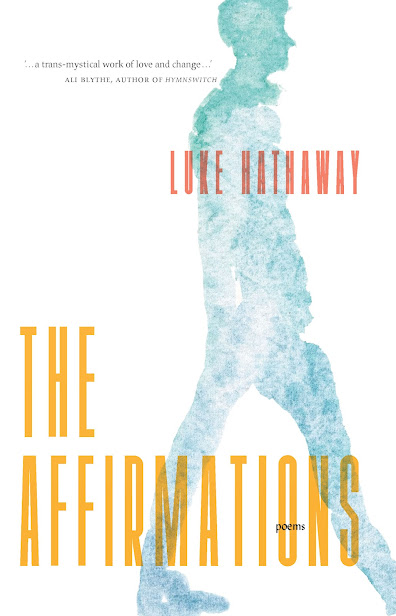
35. Luke Hathaway, The Affirmations: The fourth full-length
poetry title, following Groundwork (Windsor ON: Biblioasis, 2011), All
the Daylight Hours: poems (Toronto ON: Cormorant Books, 2014) and Years,
Months, and Days: poems (Biblioasis, 2018), by Halifax poet and
composer/librettist Luke Hathaway is The Affirmations (Biblioasis, 2022),
a book that examines, as much as anything else, poetic form. For example, the second
piece in the collection is the extended “NEW YEAR LETTER,” a ten-part
epistolary experiment across a dozen pages that opens with a lyric explanation,
citing W.H. Auden’s own work in the form, the book-length poem New Year
Letter (1941). Hathaway sketches precision narratives across rhythms as
skin across a drum, tightening the lyric when required, for higher effect. “The
lights when on / and instantly // I saw it: you,” he writes, to open “EROS AND
PSYCHE,” immortal; I, // consigned to any / trial your mother // might devise /
(beans, rice, // golden fleece / in the thorn tree, // pick-up Styx): [.]” His
is a storytelling lyric, perhaps echoing the story-and-song-telling of the
libretto, composing examinations and observations and narratives that lean into
the ethereal of lyric patters, lullaby, epistolary, essays and operatic nocturnes,
and a wordplay of grand theatrical gestures. Hathaway seems to explore the boundaries
of poetic form as it relates to an operatic storytelling, pushing at the edges
of older forms with a new hand, and a new eye, and seeing what just might be possible.
See my full review here.

36. Victoria Mbabazi, FLIP: Self-described in their
bio as “their second and third chapbook” is Brooklyn-based poet Victoria
Mbabazi’s full-length FLIP (Toronto ON: knife|fork|book, 2022),
following on the heels of their chapbook debut, chapbook (Toronto ON: Anstruther
Press, 2021). Produced as a flip-book, “SHE DOESN’T COME BACK” and “SEND MY
LOVE TO IVY,” the poems in FLIP exist as a series of self-contained monologues,
performative and theatrical gestures that sweep up against hesitation and pause
at breakneck speed, writing sex, Biblical characters, pop culture and politics,
queerness and blackness. “I don’t have it in me to be polite all the time a
phone service wants me to / talk about mental illness as a thing to overcome
but let me melt into it,” they write, as part of “FEMME FATALE,” “when a bitch
hurts me I do not wish her well let me be pre and post / traumatic I know you
find me stressful you hate perfection even its illusion [.]” There is a rush to
their lyric narratives, offering breathless stretches, hard stops and song lists.
They write of dreams, and sun, gender, sex and heat. Or, as the poem “REFRIGERATOR
WOMAN” begins: “I don’t have to be a woman to be treated like one you like me
the way you / know me by your side a frame for portrait your night in day I’m the
sun / spinning round the earth you are happy for me as long as I keep you warm
/ if the heat is bearable [.]” See my full review here.

37. Annick MacAskill, Shadow Blight: Halifax poet Annick
MacAskill’s latest—after No Meeting Without Body (Kentville NS:
Gaspereau Press, 2018) and Murmurations (Gaspereau Press, 2020)—is Shadow
Blight (Gaspereau Press, 2022), a book that works through, as the back cover
offers, “the pain and isolation of pregnancy loss through the lens of classical
myth. Drawing on the stories of Niobe—whose monumental suffering at the loss of
her children literally turned her to stone—and others, this collection explores
the experience of being swept away by grief and silenced by the world.” Shadow
Blight opens with all potential and possible ghosts before drifting through
a contemporary into a backdrop of mythological figures, writing the enormity of
loss and the slow and sudden loss into and through the isolating realities of
rage and grief. There is a way that MacAskill writes her way through the
threads of myth, utilizing the details of myth as a means to work her way
through, beyond a simple retelling, is reminiscent, slightly, of North Georgia
poet and editor Gale Marie Thompson’s recent Helen Or My Hunger (YesYes
Books, 2020). One should mention, also, American poet and translator Niina
Pollari’s Path of Totality (Soft Skull Press, 2022), a collection that
more overtly and directly writes “about the eviscerating loss of a child, the
hope that precedes this crisis, and the suffering that follows.” In comparison,
MacAskill writes not as diary but working through the portrait of such a loss
through the lens of the stories of mythological Greek women. “But a woman can
do anything in her pain,” she writes. Or, as the poem “First Snow” offers: “She
scales // the choss, and on the way, ties Proserpine’s yellow ribbon / across
the slim arm // of a spontaneous birch tree.” See my full review here.

38. Conyer Clayton, But the sun, and the ships, and the fish,and the waves: The second full-length poetry collection from Ottawa poet,
editor, musician and gymnastics coach Conyer Clayton, following the 2021 Ottawa
Book Award-winning We Shed Our Skin Like Dynamite (Toronto ON: Guernica Editions,
2020) is But the sun, and the ships, and the fish, and the waves. (Vancouver
BC: Anvil Press, 2022), edited and produced through Stuart Ross’ A Feed Dog Book
imprint. Composed as a suite of prose poems around childhood, loss, CPTSD, trauma
and dream abstractions (some of which appeared earlier as an above/ground press
chapbook), Clayton’s is a prose lyric of moments that float across narrative,
accumulating as would a photo album into a larger story of memory and survival.
As part of the acknowledgments, she writes that “This book, at its core, is
about CPTSD.” She writes of shimmering absurdities and unresolved emotional
scars in physical terms, as the poem “THE BREAK” ends, writing: “I can tell you
wish I was in the water / too, sisters. I would warn you of the shifting /
sandbar, but I have to find someone to watch / my pig first. I take my hand off
for an instant / and squint against the sun to find you, and then / the pig is
gone, my sisters are gone, they’re / somewhere beyond the break, they’re there,
/ they’re there, they must be. But the sun, and / the ships, and the fish, and
the waves.” This is a powerful book, one that knows full well how to push an
effect best by pulling it back, offering a sheen and a subtlety that provide
far more strength than had she worked more direct narratives. Throughout, the surrealism
floats from light to dark, even within the same sentence or phrase, composing
poems that blur at the edges of memory, repeated images and dangerous situations.
She writes repeatedly of and around water, stories involving family members, anxiety,
body horror and assault. “One night,” the poem “DEFICIENCY” begins, “as she
struggles to sleep, she notices / small hearts dripping from her pores. She can
/ hear her pulse in every corner of the world. / Small hearts furrow her forehead
and catch in / her hair. What can she do but to gather them?” The repetitions tether
Clayton’s dream-poems together, offering a lineage, and even a rippling effect,
connecting seemingly disparate poems together into a larger tableau. As well, through
the waves of surreal memory, this is almost a book of water, whether as threat
or salve, simultaneously washing away the pain and threatening to overwhelm her
entirely. As the poem “THE MISSING PARTS OF ME” begins: “I stand in the middle
of a pond fishing as my / father and older sister watch from shore. The / water
is still and up to my waist. When I move, / the surface doesn’t ripple.” See my full review here.

39. Rhiannon Ng Cheng Hin, Fire Cider Rain: The full-length
poetry debut by Edinburgh-born Ottawa poet Rhiannon Ng Cheng Hin is Fire
Cider Rain (Toronto ON: Coach House Books, 2022), a collection set in four
sections—“Evaporate,” “Condensate,” “Precipitate” and “Collect”—that examine the
relationship between a mother and daughter amid an evolution of movement and
displacement through the metaphor of water. Across the narrative thread of Fire
Cider Rain, Ng Cheng Hin writes of migration and arrival, examining what is
gained and what is lost, and what can’t help but be left behind. “as if by
ritual, I enter a polemic / of loss,” she writes, to open the poem “HUMAN
DISSECTION LAB,” “wherein the axis of grief / lies stitched to the vein of every
/ hemlock, every arthropod, every / woman’s coarse throat.” Stretching across multiple
geographies—from North Africa to Mahébourg to “the edge of Lake Huron” and a
Greyhound bus along the 401—there are elements of the tonal structure and
familial content reminiscent of another poetry debut from earlier this year, Nanci
Lee’s Hsin (Kingston ON: Brick Books, 2022), both of which offer a lyric
examination on mothers and daughters, loss and exodus, paired but perpetually
untethered and seeking to connect. “like mother like daughter like matter like
water –” Ng Cheng Hin writes, to close the poem “THE LAWS OF THERNODYNAMICS I.”
Writing again of the narrator’s “Māmā” to close the poem “SEAMELT II,” she offers:
“I will begin where she left me / with the sound of // water on tile.”
Her
opening poem, the sequence “COEFFICIENTS OF FRICTION,” immediately sets a scene
of descriptive thickness and full-bodied phrases, offering a lyric density very
much aware of its own music and rhythms. “what breakable, half remembered bodies,”
she writes, “bent with small attritions / stratospheric relics gliding north /
in radical heaps away from
purled trees / broken porchlights, the long ache / of the autumn island fire – […]”
There is a staccato pulse of accumulated phrases and lines, writing moments of
delicate, subtle music, one atop another until the larger shape begins to reveal
itself. The storytelling element of these poems is quite strong, although including
occasions where the story gets in the way of the music and language of her
lyric, otherwise offering a resolute and gymnastic density of sound, rhythm and
meaning. See my full review here.
40. Derek Beaulieu, Surface Tension: The latest
from Alberta poet, editor, critic, publisher and visual artist Derek Beaulieu
is Surface Tension (Toronto ON: Coach House Books, 2022), an assemblage
of morphed text-as-image that examine how language, meaning and letterforms are
shaped, playing with the pure image of letterforms, continuing a structural
thread he’s been exploring in his work for years via Lettraset. Titled Surface
Tension, Beaulieu references the physical point where liquid shrinks and
reshapes into the minimum surface, offering not simply metaphor but description
of how poetic form is and can be shaped, offering a sequence of visual
sequences, each composed as a succession of text-forms in sequence, some of
which move from the recognizable into purely abstract, but every bit of the sequence
intact. The visual sequences are interspersed with prose poems that serve as
essay-sketches around the project and its applications, as the piece “FORM IS
NEVER MORE THAN AN EXTENSION OF CONTENT,” opens: “The poems are further manipulated
using photocopiers to become liquid and languid, troubling poetic logic,
perfection, and power narratives, they flow and gather, drip and congeal,
sliding off the page.” The prose poems serve, almost, as accumulative essays,
offering single-sentence mantras that serve as poetic statements, which
themselves form larger essay-shapes through their collection. See my full review here.

41. Nicole Brossard, Distantly: translated by Sylvain Gallais and Cynthia Hogue: I was gratified to see Quebecoise writer Nicole Brossard’s
latest English-language poetry title, the bilingual edition Distantly
(Oakland CA: Omnidawn, 2022), translated from French by Sylvain Gallais and
Cynthia Hogue. This is, I think, Brossard’s first solo poetry title since the appearance
of the expansive and essential Avant Desire: A Nicole Brossard Reader,
eds. Sina Queyras, Geneviève Robichaud and Erin Wunker (Toronto ON: Coach House
Books, 2020). “always I take up my cities again,” Brossard writes, to open her poem-shaped
“Author’s Note,” “the same one, or another and its plural / with a taste of seafood,
a painting by / Caravaggio, a suspension bridge, taste of / a foreign tongue
that forces me to breathe / in the slowness and speed of my other / body of vertigo
[.]” Distantly is a book of cities, as Brossard writes her lyric as
slant points along an extensive and expansive grid, of thinking, feeling and
allowing the world to exist within the body. “little by little we’ll say,” she
writes, as part of “Cities with a face,” “the count of eternity’s / crossing
our faces [.]” Distantly writes of cities and silence, location and
dislocation, and the distances one travels between, amid and through. Her poems
extend across sequential, stand-alone stanzas, stretching her line across the
page and multiple pages, something Ottawa poet Monty Reid is known for as well:
allowing the sentence a particular kind of opening—not open-ended per se, such
as Robert Kroetsch or bpNichol—but extended. Her poems, long and short, sequence
and sit together as a kind of suite or collage accumulation; less in sequence
per ce than around the central core of an image, an idea, as she writes between
and amid cities, of cities, and a dream of cities, and their inherent elements
of beauty and violence. See my full review here.

42. Kristjana Gunnars, Ruins of the Heart: Six Longpoems: Icelandic-Canadian
poet and prose writer Kristjana Gunnars’ seventh poetry collection, and first full-length
poetry title in twenty years, is Ruins of the Heart: Six Longpoems (Brooklyn
NY: Angelico Press, 2022). Given the twenty years since the publication of her prior
poetry collections Carnival of Longing (Winnipeg MB: Turnstone Press,
1989) and Silence of the Country (Regina SK: Coteau Books, 2002), the
six poems that make up Ruins of the Heart: Six Longpoems—“A Moment in
Flight,” “Fraser and Salmon,” “Threadbare,” “Black Rose With Rain,” “Under a
Winter Sky” and “Moon on Fire”—have shifted in structure from her prior
published poetry, seeming far closer to the prose essay-poem than more traditional
lyric. The first section even appeared originally in more of a prose form, subtitled
“an essay on melancholy” and produced as a chapbook through above/ground press
in 2020. There is something in the poems collected here that suggest the two structural
threads of her published work have merged—her poetry and her prose—allowing for
the best of both structures, and meeting somewhere in the middle. The “Six
Longpoems” collected here are composed as a suite of six individual examples of
meditative, sequenced thought, writing on melancholy and mortality, love and faith,
environmental devastation and the material of dailyness. “It’s such a strange experience
to outlive time like this,” she writes, to close the poem “Threadbare,” “so
strange.” Writing on time, aging and the shadow of death, there has been a
meditative quality that emerged through and within the sequence of her
novellas, but one not so prominent in her poetry as it is here. “Life in small
details.” she writes, as part of “Black Rose With Rain.” “All stable,
unchanging, without surprise. / I find myself in a world of autonomous
speakers.” A bit further down the page, offering: “The duration of things
is vast / but never empty. There is no such thing / as empty duration.” She offers
a foundation of mysticism; referencing Joyce, Siddhartha, Borges and Rumi, hers
is a lyric of beginning and endings, attending a lyric of spiritual dailyness
and lyric pilgrimage. “The Phoenician sailor said: judge me as a man / whom
the ocean has broken.” She writes of death, weightlessness and the turning
of something (being) into something else, which is also nothing. “What I would like
is to linger a while / in quiet contemplation.” There are often times that
those who work in multiple forms can have one certain readers prefer over the
other, or one more striking than the other—Elizabeth Smart the prose writer,
say, working with lyric experiment the way Elizabeth Smart the poet never could—but
this particular work seems a progression of both Gunnars’ poetry and prose
sides. No matter which element of her writing you prefer, this is where all
those threads not only continue, but meet. See my full review here.

43. Gary Barwin, the most charming creatures: poems: While he’s had
a few other poetry projects (and a novel, in case you weren’t aware) emerge
since the publication of his selected poems, For It Is a PLEASURE and a
SURPRISE to Breathe: new & selected POEMS, edited with an Introduction
by Alessandro Porco (Hamilton ON: Wolsak and Wynn, 2019)—including his full-length
collaboration with Gregory Betts, The Fabulous Op (Ireland: Beir Bua
Press, 2022), a second full-length collaboration with Tom Prime, Bird
Arsonist (Vancouver BC: New Star Books, 2022) and multiple solo and collaborative
chapbooks—the first post-selected solo poetry title by the dervishly-productive
Hamilton writer, musician and editor Gary Barwin is the most charming
creatures: poems (Toronto ON: ECW Press, 2022). The first collection after
the publication of a selected is always interesting; to look at a new work
after having examined, even if rather broad in scope, the length and breadth of
a career in poetry, and to consider that new collection across such a wide
spectrum, and not simply on its own, or even against a prior title or three. What
threads are continued? What new ground might be covered? It has the potential
to be quite a loaded approach, certainly. Anchored in humanity and play, the poems
in the most charming creatures: poems delight in language, offering
poems that are intimate and deeply felt, including poems translating and
responding to a variety of historical and literary threads, whether connecting
to older works translated into English, or dedicated to some of the writers
around his immediate vicinity. The poem “After ‘Gute Nacht’ from Winterreisse
by Wilhelm Müller,” for example, subtitled “English translation by William
Mann,” ends with: “As I leave I write / ‘Goodnight’ upon the roadside snow
/ so that, Dear Reader, / you see I have been thinking of you [.]” The poem “How
to End a Poem,” dedicated “for Terese Mason Pierre,” offers: “burnt
words / delivered in an envelope / to the mother of your enemy // the mother of
your enemy / is a mirror // you’re the mirror […]” Composed as shorter poems, most
of which are self-contained or grouped into gatherings, the pieces here suggest
almost as a collection of occasionals, which themselves have grouped into the
occasion, one might say, of the book itself. There’s a way through which Barwin’s
surrealism and play with puns and banter display, most of all, a deep empathy and
engagement with others, something always present in his work, but somehow more
forefront through the poems in this particular collection. And perhaps that, by
itself, is the difference here: Barwin wearing his heart so openly, while still
allowing language and play to swirl around that particular centre. See my full review here.

44. Natalie Wee, Beast at Every Threshold: A follow-up to
Natalie Wee’s full-length debut, Our Bodies and Other Fine Machines (special
edition, San Press, 2021) is Beast at Every Threshold (Vancouver BC:
Arsenal Pulp Press, 2022), a collection of narrative poems comprised as journal
entries, akin to an assemblage of diaristic reports or essay-poems captured
through a densely-packed, descriptive, first-person lyric. “I can name any
season,” begins “FREQUENT FLYER PROGRAM,” “but the trees I love will die //
where they are. That’s what it means to become a light // year, to become
memory: never stay long enough / to speak belonging the way ocean pronounces
the sky, […]” These are poems that examine, react and respond, seeking out solutions
and articulating problems, carving deeply personal and deeply felt lines across
a meditative lyric. “I pray its name,” she writes, mid-way through “SELF-PORTRAIT
AS POP CULTURE REFERENCE,” “& so undertake the undertaker, it preys my
Mandarin name / so I watch Chinese dramas with bright-eyed bodies // to
forestall forgetting my own. I’ve watched my skin / turned fragrant ornament
thrown over women // the colour of surrender & they were praised for wearing
it.” Reminiscent of others working essay-poems examining sometimes complicated
or even difficult personal and cultural histories, whether Phil Hall or Susan
Nguyen, Wee’s poems are song-sharp, hum with energy and verve, composed of
lines that hold the ability to simultaneously carve, cut and caress; so damned
sharp and precise, even enviously so, that one could bounce a quarter off them.
“My love,” she writes, as part of the poem “ASAMI WRITES TO KORRA FOR THREE
YEARS,” “what we make of loss is a sport / that kills.” Composed with a descriptive
thickness, she writes of truth and consequence; she writes on cultural and familial
lineages and inheritances, seeking both to connect with and determine the
precise impact they’ve had upon her. See my full review here.

45. Sarah Ens, FLYWAY: Winnipeg poet Sarah Ens’
second full-length poetry title, following The World Is Mostly Sky (Winnipeg
MB: Turnstone Press, 2020), is FLYWAY (Turnstone Press, 2022). Subtitled
“a long poem,” FLYWAY is a collection that engages a long poem structure
of fractured fragments that accumulate and stagger, writing on and around
notions of home and geography in ways clearly influenced by generations of
prairie (and even, specifically, Winnipeg) poets. Enn’s structures include
echoes from multiple Turnstone titles over the years, including Dennis Cooley’s
Irene (1999), for example, or Sarah Gordon (now Swan)’s Rapture Red
& Smoke Grey (2003); I think of Robert Kroetsch’s Seed Catalogue
(1977), Marvin Francis’ city treaty (2002), Sylvia Legris’ iridium
seeds (1998) or Rob Budde’s Catch as Catch (1995). Enn’s fragments
stagger, layer and build across a book-length stretch of long poem, writing of
home and grandmothers, European escape and arrival in the Canadian prairies. This
is a collection of being and becoming, writing out what is lost, gained and
abandoned; writing out what is inherited, and what can’t help but be carried
across not only distances, but generations. Set in three numbered sections of “Tallgrass
Psalmody,” with a European sidebar-section “Flight / 1929-1945” between the
first two, Ens articulates a mapping of arrivals and departures between Europe and
Manitoba, laying a subject matter and structure that emerged across the prairie
landscape of the 1970s and into the 80s, but set through Ens own particular
lens. “The war ended but the world unended.” she writes, as part of “Flight,” “Mother
said / Keep your eyes and ears open and everywhere.” Hers is a lyric, a
music; less a college or fragment than an accumulation. In many ways, her lyric
is akin to Cooley, writing a progression across the larger story of the
rippling effect of emigration across two or three generations. “Come /
magnetic,” she writes, as part of the first section, “come urging, / orient in
/ migrant’s memory.” A page later offering: “I read: what we did to survive
// I stand in the switchgrass / & read the wind the way I want it.” See my full review here.

46. Kate Hargreaves, tend: poems: The second full-length
poetry collection by Windsor, Ontario poet, designer and roller derby maven
Kate Hargreaves is tend: poems (Book*hug, 2022). Through tend, Hargreaves
writes first-person narrative short form lyrics on city gardens, self-care,
rootedness and patterns; she writes of tentative splits, scars, overgrowth and
frayed edges. “The x-ray tech shoots film of my insides,” she writes, as part
of the poem “an early gift for February 14” (a poem that begins on page
fourteen, curiously enough), “says I can pay five dollars to download the snaps
/ from home. / save them to my ‘personal PC’ to respond to / requests to
sendnudes. // Lower torso minus clothes, / minus skin minus organs. // Just
bones and a / white T / Autoreply to
a dick pic.” Throughout the collection, her poems offer tics and staccato
through a gymnastic collage of language, sound and syncopation reminiscent of the
work of Christine McNair (who also provides a back cover blurb for this particular
work), one that speaks to propel with breakneck speed. Listen to the cadences
of the poem “pattern,” for example (a poem I would be eager to hear aloud),
that writes: “Turnaround, loop back. Beg together (tog) again. Sk ahead to
third / date. Cut off loose ends. // Sl off. Reduce space. Double2tog in F(our)P(oster).
/ reptog. / reptog. // Sk single hookups. 1 st in time sv (save) 9.” There are
ways that Hargreaves utilizes rhythm throughout the poems assembled here that
is quite interesting, allowing a breathless, halting or otherwise propulsive patter
to further her poems as much as anything involving language, meaning or purpose.
In the sequence “other people’s dogs,” the narrative of each short burst propels
forward through curling back up into itself and inside out in really sharp and
delightful ways. There are some really magnificent and powerful shifts, eddys
and pivots in these poems, offering a subtle and delightful patter blend of
sound and rhythm across some dark and difficult meanings. tend is a
collection of poems that examine and articulate the weight of expectation,
daily tasks, instincts and ghosts; Hargreaves writes of routine, gardening and
a relationship to nature, including her ongoing wish to compost (which may
never actually happen, as the poem suggests), as she offers in the poem “I will
be a person who composts,” that begins: “who buys brown-spotted eggs direct
from the chickens / Why never scoops out the blood spots / or tosses shells in
the trash. / I will wash and sort my recycling. / I will bundle cardboard with
rough string and gift-tie it / in neat bows. / I will cook fresh soups from
scratch.” In many ways, tend is an optimistic and occasionally joyful collection
of dark complexities, centred around care, from self-care to gardening, and the
ways in which we wish to interact with the wonderfully complex and convoluted
worlds of nature, other humans, poems and ourselves. See my full review
here.

47. Sophie Crocker, Brat: The full-length poetry
debut by Sophie Crocker, “a writer and performance artist based on stolen
Songhees, Esquimalt and WSANEC land,” is Brat (Guelph ON: Gordon Hill
Press, 2022), a scattering of poems that work to explore and feel out a variety
of self-definitions and self-determinations, through which to see which one or
ones best fit. “i don’t want to miss anything before i have to.” they write, as
part of the opening poem, “venus in cancer.” “i / can’t even finish a podcast,
can’t even keep a middle name.” There is such delightful and open uncertainty infused
in Crocker’s narratives, and their expositions flick at a moment’s notice
between meditation and flailing, wild exuberance and cool wisdoms, so many of
which seem hard-won. The same poem, after weaving and bobbing a meandering pace,
ends with the clarity of such a wonderfully-paced and slightly-open conclusion:
“actually, my last meal will be breakfast. / after breakfast i will take a
long, / long walk.” Crocker engages with numerous poems around situating, composing
multiple portraits-within-moments across an immediate self, including “self-portrait
as angel baby,” “self-portrait in leo,” “self-portrait in virgo,” “neptune in capricorn,”
“self-portrait in aquarius” and “the best thing about me.” They offer moments
and morsels of and around perspective, and portraits around all twelve astrological
signs. “i should like to be dismantled.” they write, to open “self-portrait of
the obsessive compulsive / in isolation,” “a white onion. / my skull still
soft. the apartment half-moved-out.” The ways through which Crocker constructs
a book-length in-process portrait, working line by line, poem by poem, is fascinating;
and Crocker’s staccato-accumulations are, at times, combative, meditative,
lyric, self-depreciating, self-aware, sly, hilarious and deeply curious, seeking
answers to impossible questions that are still, in themselves, to find their
final form. “there were too many corners / in too many rooms.” they write, near
the end of “that summer i thought i was gautama buddha,” “my rage monsooned /
into every flesh i had.” See my full review here.

48. River Halen, Dream Rooms: Produced as the fifteenth
in Book*hug’s “Essais Series” is Montreal poet and editor River Halen’s latest poetry
title, Dream Rooms (Toronto ON: Book*hug Press, 2022). Dream Rooms
is self-described as “part essay, part poem, part fever dream journal entry,”
set as a book-length exploration “about personal revolution, about unraveling a
worldview to make space for different selves and reality. Set in the years that
led up to author River Halen coming out as trans, this collection concerns
itself with what sits on the surface of daily life, hidden in plain view,
hungry for address […].” The table of contents offer but eleven poems in the
collection, although these exist in the larger structure of the collection
almost as signposts, or even Greek Chorus, offering dated journal-esque entries
in sequence as the tether that runs across and through between these pieces. “There
were no women in my childhood,” they write, as part of the opening poem, “SELF
LOVE,” “in books or real life / just men and cows— / the women I loved were all
men / and the women I didn’t, cows. / No women in this exploration, either /
just a man and a cow / and I was both—I did not know / how profoundly—this hurt
[.]” Perhaps, at times, certain of these titles might be set as
section-openers, simply highlighting where the next stretch of Halen’s
explorations begin, grouping each short selection of prose poems underneath a kind
of banner. “When I go to the bathroom / to cry about your failures,” Halen
writes, to open the poem “REASON,” “I do it just like you / if you were me /
watching the mirror / to see if sympathy is possible / then trying my best / to
cry more beautifully.” Halen, the author of a handful of poetry collections,
works in this collection to situate themselves through and including their coming
out as transgender. “So there was never any pure time / if pure time exists for
anyone,” they write, to open the extended poem “HONEYMOON,” “I do not know [.]”
In Dream Rooms, Halen simultaneously reveals and creates a new kind of
space for themselves in the space of their own body, and their own body in space,
one occupied by family, friends and current and former partners. Halen’s
sentences reveal and invoke, blending the best that their poetry and
non-fiction through this multi-faceted examination of form, from gender
identity and the prose essay through the poetry day book. This, one might say,
is the story of the thinking around that particular experience, and that
particular time. See my full review here.

48. Daniel Scott Tysdal, The End Is in the Middle: Toronto poet Daniel
Scott Tysdal’s work has long been engaged with an irreverent and conceptual
structural inventiveness and play on and through poetic form, offering a
particular flavour unique in writing and publishing generally, but very much unique
through Canadian writing. Anytime I’m moving through a new collection of his, I
wonder: exactly where did this guy come from? The author of the poetry titles Predicting
the Next Big Advertising Breakthrough Using a Potentially Dangerous Method
(Regina SK: Coteau Books, 2006), The Mourner’s Book of Albums (Toronto
ON: Tightrope Books, 2010) and Fauxcacassional Poems (Fredericton NB:
Goose Lane Editions/icehouse poetry, 2015), as well as the short story
collection Wave Forms and Doom Scrolls (Hamilton ON: Wolsak & Wynn,
2021) and the poetry textbook The Writing Moment: A Practical Guide to Creating
Poems (Oxford University Press, 2013), his latest title is the poetry
volume The End Is in the Middle (Goose Lane Editions/icehouse poetry,
2022). His work exists as a curious outlier, coming at form and pop culture
from the seemingly-oddest angle, and his outlier status seems moreso through his
publishing books with presses not known for producing experimental work (it isn’t
lost on me that one of the blurbs on the back cover is by Saskatchewan poet
Sylvia Legris, arguably another Canadian poet outlier). Tysdal’s latest, The
End Is in the Middle, works through the structure of the infamous Mad
Magazine fold-in, something just about everyone of at least two or three
generations would be entirely familiar with. Arguably, most if not all poetry
exists with a requirement for the reader to make connections not overtly in the
body of the poem, however directed their reading might be by the author, rarely
is the requirement of the reader so physical. I’m reminded of bpNichol’s
unreleased and burnable mimeo poem Cold Mountain (no date, but circa
1960s), a visual poem built to be curled, stood up and set with a match; although,
in comparison to Tysdal’s folding structure, nothing new is specifically revealed
in or through Nichol’s text by the reader doing such a thing. For Tysdal, the requirements
for such a piece are immense, offering a narrative echo of the Jaffee’s jumbling
visual collage that offered a final reveal that provided a gag as well as new
insight into that original, sprawling page. That original A to B is hardly as
uncomplicated as it sounds, and to even be a single line, a single letter, off
would mean the entire piece might fall apart. And for the benefit of those who don’t
wish to mangle their copies, as well as for accessible reasons, the final revealed
text is also offered on each following page. It would be curious to know, down
the road, how many readers actually did attempt to fold the pages together to reveal
the final, hidden line of each poem as it is meant to be experienced. Even jwcurry,
bpNichol bibliographer, has said that Cold Mountain was best experienced
as a pair: one copy to burn, and one copy to keep pristine. See my full review here.

49. Cameron Anstee, Sheets: Typewriter Works: It is
wonderful to see Ottawa poet, editor and publisher Cameron Anstee’s second
full-length poetry title, following Book of Annotations (Picton ON:
Invisible Publishing, 2018), his Sheets: Typewriter Works (Halifax
NS/Toronto ON: Invisible Publishing, 2022). “This book began,” as he begins his
“SOME AFTERWORDS” that end the collection, “following the death of my friend,
the poet William Hawkins, on July 4, 2016, when I was gifted his Olivetti
Lettera 30 typewriter.” Composed entirely, it would seem, upon the legendary late
Ottawa poet and musician William Hawkins’ typewriter (and produced to replicate
that particular typeface), Anstee’s Sheets: Typewriter Works furthers
Anstee’s poetic explorations into and through the minimal, but through gestures
that extend both the act and result of writing—both composition and erasure—into
the deeply physical. The effect is striking and immediate, as one catches the imperfect
image of the text on the page, and the occasional letter slightly askew. The process
is reminiscent of how, years ago, Ottawa poet, publisher and bibliographer jwcurry
spoke of curating his 1cent series of publications—each of which are poems
produced through individually hand-stamping from a child’s set, one phrase or
line at a time—as being curated, in part, through that measure of physicality: completely
refusing a production aesthetic of publishing ease. It was one thing to love a
poem enough to hand-print the one time, but fifty, or even one hundred times? How
much might one have to love a poem to hand print it, line upon line, one
hundred and fifty times? One might think that very few poems might survive such
a requirement. And so, too, to Anstee’s minimalisms: potentially condensed even
further through the physical act of composing upon a fifty year old typewriter.
Sheets: Typewriter Works includes poems-in-homage, specifically through
the two “Afterworks” sections, to creators such as Barbara Caruso, Jiří Valoch,
Kate Siklosi and Dani Spinosa, Alex Porco, PSW, Mary Ellen Solt , Phyllis Webb,
Nelson Ball, bill bissett and Nicky Drumbolis. But in the larger sense, Sheets:
Typewriter Works holds an echo of Kingston writer Michael e. Casteels’ The
Last White House at the End of the Row of White Houses (Invisible
Publishing, 2016), or, more specifically, Toronto poet Dani Spinosa’s OO:
Typewriter Poems (Invisible Publishing, 2020), in how he appears to approach
this work as a kind of poetic study, one centred around the possibilities of
the physical poetics of this generation of typewriter, as well as a variety of
generations of typewriter poets. As his “NOTES TO THE POEMS” offers: “This book
exists in conversation, directly and indirectly, with past and contemporary
typewriter poets, and while I will not hazard to offer an inevitably incomplete
list of the works and writers that are in the DNA of this book, the pieces in
Afterworks I and Afterworks II, and their respective notes below, offer a
partial glimpse of some of the reading and looking and thinking I was doing
while working.” See my full review here.

50. Cecily Nicholson, Harrowings: The latest
from Vancouver poet Cecily Nicholson, following Triage (Vancouver BC: Talonbooks,
2011), From the Poplars (Talonbooks, 2014) and the Governor General’s
Award-winning Wayside Sang (Talonbooks, 2017), is Harrowings
(Talonbooks, 2022), an expansive lyric structure of fragments around agriculture,
sustainability, legacy and responsibility. Centred around the physical act of
planting, Harrowings writes on agriculture and ethical sustainability, placement
and displacement, offering, as the back cover writes: “[…] pulses of memoir
from the poet’s childhood growing up on a farm, as well as from more recent
pandemic experiences volunteering for a local agricultural enterprise led by
people who were formerly incarcerated. Considering movements organizing for
food security and related, resurgent practices, HARROWINGS also contends
with ‘the farm’ as a tract of colonial advance.” Nicholson manages the lightest
touch of lyric across the line, across the canvas of the open sequence, writing
such weight through an evocative language, and such lovely music across a
poetry of both document and witness. “the lake over stern draws,” she writes, amid
her “correspondences,” “agitation welds // worth what power concedes // for
four nights with shore as the lake leaves and returns / speaking of sturgeon //
to witness ospreys / the dry mouth of the streambed, physical confines for
future water [.]” See my full review here.

51. Otoniya J. Okot Bitek, A Is for Acholi: Award-winning Kingston,
Ontario-based poet and critic Otoniya J. Okot Bitek’s second full-length collection,
after 100 Days (Edmonton AB: University of Alberta Press, 2016) is A
Is for Acholi (Hamilton ON: Wolsak & Wynn, 2022), a book-length poetic
that works to articulate, dismantle and reconstruct an alphabet of being, seeking
and belonging. “A is for Acholi Achol the Black one & the black one,” she
writes, to open “An Ancholi alphabet,” “A is for the apple that was lobbed at
us from a garden far away & exploded in our compound / A is for me [.]” A
Is for Acholi is an expansive poetic through the archive, offering history,
story and histiography, writing of diaspora and colonialism and dismantling racist
depictions, all held together through such thoughtful and delicate construction.
Bitek writes of homeland and of home; she writes of loss and of song and of standing
firm on the present ground. “these days like loose threads like untied laces
like / frayed edges like tenuous connections,” she writes, to open the single
stanza (and punctuation-less) prose-block “An alphabet / for the unsettled,” “days
like remembrances days like bits we can only access / if we’re to survive days
that are untenable / palpable days pulsating through that prominent / vein on
your temple days like memories you can’t / hold onto like last tuesday which
means nothing at / all except that there was a tuesday last week [.]” See myfull review here.

52. Phil Hall, The Ash Bell: The latest from Ontario
gothic and Perth-based poet and editor Phil Hall is The Ash Bell
(Toronto ON: Beautiful Outlaw Press, 2022), a sequence of thirty numbered and
extended meditations/poem-essays in a lyric structure as much adapted by him as
established. Collected and compiled by innumerable fragments of conversation,
reading, recollection and meditation, Hall’s lyric always gives the impression
of being constantly in flux: reworked, rearranged and repurposed. Over the past
twenty or so years, Hall’s collage-poems have become increasingly carefully and
thoughtfully stitched-together, providing a casual, almost “aw, shucks” manner
to an intricately-precise poetic and purposeful lyric. “A boy is peeing,” he
writes, as part of “18 Verulam Revisited,” referencing the sequence that originally
appeared as above/ground press chapbook, later part of his award-winning Killdeer
(Toronto ON: BookThug, 2011), “in a woodshed // & staring at a doe’s
tongue as it drips blood / she hangs by her hind hooves from the roof // her tail open to write north of anecdote [.]” Anyone familiar
with Hall’s prior work will not only recognize familiar subjects in his work,
but certain elements of call-back, as he thinks through his lyric across childhood
abuse, Emily Carr’s artwork, conversations with Robert Kroetsch, parenting,
correspondences, Charles Olson, the Rideau Canal Museum, photography, local
history, memorials and multiple other threads. His lyric seems unique, in part,
through the sheer amount of simultaneous conversations with other writers, artists
and works that his poem-essays engage with, many of which are conversations that
have been going on in his work for years. See my full review here.

53. Edward Byrne, Tracery: I’ve been enjoying the
poetry collection Tracery (Vancouver BC: Talonbooks, 2022), the latest
from Vancouver poet and editor Edward Byrne, a lyric meditation of in-transit pinpoints
and sequences that collect together to form a kind of thinking portrait of
daily and domestic thinking. His poems are composed via short takes and
phrases, accumulations of hesitations, pauses and small points, akin to a lyric
reminiscent of the poem-length lineations of Monty Reid, Cameron Anstee, the
late Nelson Ball, or possibly Robert Creeley: each poem offering a meditative
slice of dailyness composed through a single, ongoing, staggered line. “You are
a point of no return,” he writes, in part six of the numbered thirty-poem
sequence “MORNING SONGS,” “this and every morning / where my thoughts / exit
from dream’s grasp / never grasped / all the little signs / all your stars blinking
out [.]” Byrne composes a precision of small points along a continuous thought,
offering a pacing of slow, accumulative and artful steps, each one carefully
set. As the first poem in the six-poem sequence “(TRAME)” reads: “This morning
on Union Street / I saw Arthur Rimbaud on a girl’s bicycle // And then / close behind
him / Jean Seberg // They smiled at me and waved // Then came Antonin Artaud /
weaving and shouting curses // None of them wore helmets // I worry about their
heads / which I adore [.]” Byrne’s pacing demands an attentive eye, composed
with care across each phrase, each line. His poems exist simultaneously in the
present moment as well as across vast distances, allowing the short form to
contain such enormous volumes. Composed, as the back cover offers, “in a time of
plague, through dreams and daily life,” Byrne moves easily through his translations
of lyric form and the shimmering space between dreaming and daily tasks,
catching memories across the dawn’s sweep of early morning clouds. He traces
his lyric, one might suggest, around and through the minutae of his present
moment. And, closing the collection, his engagements with responding to works
by poets such as Blaser, Aragon, Rilke, Artaud, H.D. and Dante allow for the
shape of not only influence but response, offering a lyric of experience and
fine craft. See my full review here.

54. Amy Dennis, The Sleep Orchard: A Response to Arshile Gorky: Having
produced her chapbook THE COMPLEMENT AND ANTAGONIST OF BLACK (OR, THE DEFINITION
OF ALL VISIBLE WAVELENGTHS) through above/ground press back in 2013, it is such
a delight to see the full-length debut by Ontario poet Amy Dennis: The Sleep
Orchard: A Response to Arshile Gorky (Toronto ON: Mansfield Press, 2022). The
Sleep Orchard is presented as a poetic response to the work of the late Armenian-American
Abstract Expressionist painter Arshile Gorky (1904 – 1948), who, as a contemporary
of Mark Rothko, Jackson Pollock and Willem de Kooning, was considered one of
the most powerful American painters of the 20th century. “You loved me
because I looked / like that period of Picasso,” she writes, as part of the sequence
“MARNY GEORGE / AT 36 UNION SQUARE,” “when the walls were taken off / Pompeii.
My pelvic cradle // a lava pond / filled with pottery / and ancient shards. I am
almost dead / now. And you are ash in the meadow.” Dennis composes her book-length
response via a sequence of self-contained narratives, each of which is set as a
single step along a longer path; steps, or perhaps tarot cards: she turns over
a card, each one offering a perspective that shifts, slightly, what might have
come prior. And it is through this progression that she works to establish her
portrait. As she writes to open the poem “STAGNATION, SWELL, / A SUDDEN FLESHING,”
“The artist, / his hands, his mother’s absent / hands, painted over as clay blocks
// because there’s no real way / of reaching.” There is something in the way
Dennis works to not simply write through but into the work of Gorky,
discovering, as well, the points where the artist and author begin to meet. See my full review here.